
“The action of climate seems at first sight to be quite independent of the struggle for existence; but in so far as climate chiefly acts in reducing food, it brings on the most severe struggle between the individuals… Even when climate, for instance extreme cold, acts directly, it will be the least vigorous, or those which have got least food through the advancing winter, which will suffer most.”
— Charles Darwin, On the Origin of Species by Means of Natural Selection; or the Preservation of Favoured Races in the Struggle for Life (London: John Murray, 1859), Chapter III, “Struggle for Existence.” https://archive.org/details/darwin-online_1859_Origin_F373
“The greatest benefits will come from being better at preventing [disasters] and living with their effects than by trying to respond to them after they have happened.”
— The Economist, “Europe’s Fires Are Just the Start,” July 28, 2026. https://www.economist.com/leaders/2026/07/28/europes-fires-are-just-the-start
Abstract
The summer of 2026 has underscored the growing interconnectedness of global climate risks. Record-breaking wildfires across Europe have coincided with the emergence of a strong El Niño in the eastern equatorial Pacific, raising concerns about cascading ecological, public health, and economic impacts. In this note, I examine these converging climate shocks through an interdisciplinary lens that integrates climate science, conservation biology, public health, disaster-risk financing, and development policy, and discuss the risk posed for the unique and fragile ecosystem in Ecuador’s Galápagos Islands. Drawing on historical experience from the 1982–83 and 1997–98 El Niño events, contemporary scientific forecasts, and lessons from Ecuador’s institutional response, I argue that resilience depends not only on responding effectively to disasters but on investing in preparedness before they occur. The note reviews advances in early warning systems, conservation finance, adaptive public health strategies, and pre-arranged financial instruments such as the World Bank’s Catastrophe Deferred Drawdown Options (Cat DDOs), demonstrating how these mechanisms can strengthen anticipatory action. Although focused on the Galápagos Islands, the analysis offers broader lessons for climate-vulnerable regions confronting increasingly frequent and interconnected environmental shocks. It concludes that effective climate adaptation requires integrating scientific foresight, biodiversity conservation, resilient public health systems, flexible financing, and adaptive governance into a coherent framework for anticipatory resilience.
Keywords: El Niño; Galápagos Islands; climate change; anticipatory resilience; disaster-risk financing; Cat DDO; conservation finance; biodiversity; public health; One Health; climate adaptation.
I. Introduction
As the summer of 2026 unfolds, an extraordinary convergence of climate-related events has highlighted the increasingly interconnected nature of global climate risk. Recent travels to Ecuador to participate, as a Governing Member, in the General Assembly of the Charles Darwin Foundation for the Galápagos Islands (Marquez 2026c), followed by travel through Southern Europe and observations from my home in the United States, have brought me face to face with the human and ecological consequences of climate disruption unfolding almost simultaneously across three continents.
Developments during recent weeks have been equally alarming. France has experienced an unprecedented combination of successive heatwaves, prolonged drought, and destructive wildfires (Image 1 below). Temperatures reached as high as 44.4°C (112°F), while major fires advanced to the outskirts of Paris and threatened the metropolitan area of Bordeaux (Schwartz 2026). On 27 July 2026, President Emmanuel Macron convened an emergency cabinet meeting as a rapidly expanding wildfire approached within 15 kilometers of Bordeaux, a metropolitan region of approximately 850,000 inhabitants (Al Jazeera 2026a). Bordeaux’s mayor, Thomas Cazenave, described the blaze as remaining at the gates of the metropolitan area, while Interior Minister Laurent Nuñez told France 2 television that the fire was not under control and that the overall situation was unprecedented (Al Jazeera 2026b; Associated Press 2026). Jérôme Steffe, mayor of the nearby commune of Cestas, called it a fire of a size never seen before (IBTimes UK 2026). The blaze generated a fire-driven storm system producing winds and lightning that seeded further ignitions on already arid ground, hindering containment efforts.
The humanitarian consequences have been severe. Roughly 220,000 people were evacuated in the Gironde department alone, with a second fire in the Landes displacing a further 36,000 and the total across southwestern France exceeding 250,000 (Associated Press 2026). The Gironde prefecture reported 240 homes destroyed and 75 firefighters treated for injuries. The activation of the European Union Civil Protection Mechanism underscored the magnitude of the crisis, which President Macron described as a completely unprecedented wildfire and the toughest France has faced since the Second World War (Al Jazeera 2026b).
Across the Pyrenees, Spain is experiencing a similarly severe fire season. By late July 2026, more than 170,000 hectares had burned nationwide, according to the Ministry for the Ecological Transition—several times the area affected during the same period in 2025 (El País 2026; eldiario.es 2026). The largest fire area, spanning the provinces of Ávila and Madrid, exceeded 70,000 hectares and developed a perimeter of more than 160 kilometers. Spanish authorities describe this as the largest fire in the country’s recorded history, and regional president Isabel Díaz Ayuso called conditions endemoniada (hellish). A second major fire at Vall d’Uixó in Castellón had consumed some 4,300 hectares and forced the evacuation of more than 16,000 people from eighteen municipalities (eldiario.es 2026). Prime Minister Pedro Sánchez, visiting the affected areas, warned that difficult hours lay ahead as another heat wave approached. Combined evacuations in France and Spain surpassed 300,000 people, illustrating how prolonged heat, drought, and extreme fire events transcend national borders (Laizans and Pinedo 2026).
Figure 1: Racing to Curb Wildfires
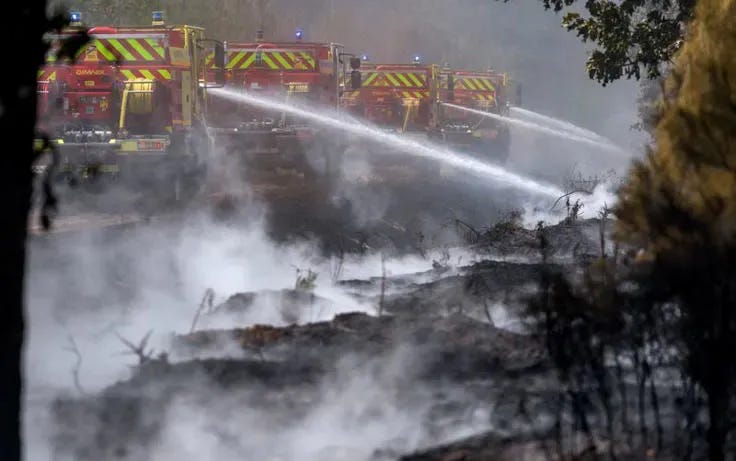
Source: Photograph by Florion Goga/Reuters. Reproduced from Laizans and Pinedo (2026).
The fires represent the culmination of an extraordinary European heat season, which began in late May and has run in episodes far above seasonal norms across the United Kingdom, Ireland, France, Germany and the Iberian Peninsula (Copernicus Climate Change Service (C3S) 2026a). June 2026 was deem to have been the warmest June ever recorded in Western Europe, averaging 20.74 °C (69.3 °F)—3.05 °C (5.5 °F) above the 1991–2020 mean—narrowly surpassing the record set only twelve months earlier, when the region averaged 20.49 °C (68.9 °F), or 2.81 °C (5.1 °F) above that baseline (C3S 2026b, C3S 2025). Two consecutive years of record-breaking temperatures are more than statistical anomalies; they suggest that the climate baseline itself is shifting. Much of Europe’s urban infrastructure, including its housing stock, was designed under the assumption that widespread air conditioning would remain unnecessary. That assumption is rapidly being overtaken by an ominous climatic reality, with the greatest health impacts falling on older populations and vulnerable urban communities.
These climate-related disruptions extend well beyond Europe. During July 2026, Canada experienced 876 active wildfires simultaneously, while more than 3,500 fires had consumed over six million acres since the start of the 2026 fire season, spreading smoke across much of North America (CNN 2026; Clarity 2026). Air quality deteriorated dramatically across large areas of the United States. Chicago recorded a one-hour PM₂.₅ concentration of 471.8 µg/m³—fine particulate matter small enough to penetrate deep into the lungs and enter the bloodstream—against a U.S. 24-hour standard of 35 µg/m³ and a World Health Organization guideline of 15 µg/m³ (WHO 2021). That reading corresponded to an Air Quality Index (AQI) of 481, where values above 300 are classified as hazardous. The Baltimore–Washington metropolitan region, where my family and I reside, registered daily average PM₂.₅ concentrations approaching 200 µg/m³, nearly six times the U.S. National Ambient Air Quality Standard, prompting Code Purple alerts under which everyone—not only sensitive groups—is advised to limit outdoor activity (NASA 2026; Clarity 2026). At the peak of the episode, more than 100 million Americans were under air quality alerts (NBC News 2026).
The above events illustrate a broader transformation underway. As Wallace-Wells (2026) argues, climate change is turning extreme wildfires and hazardous smoke from episodic disasters into recurring features of everyday life. The implications extend beyond emergency response. They point toward a future in which resilience increasingly depends on anticipatory adaptation, adaptable infrastructure, ecosystem management, and preventive public health investments undertaken before climate shocks occur.
The public health consequences reinforce this conclusion. Recent analyses, as illustrated in Figure 1, estimate that exposure to wildfire-generated PM₂.₅ was associated with nearly 164,000 deaths in the United States between 2006 and 2020 (Climate Central 2025). Attribution studies further demonstrate that anthropogenic climate change has significantly increased wildfire-related smoke exposure and its associated mortality burden (Law et al. 2025). Looking ahead, Qiu et al. (2025) project that climate-driven wildfire smoke could eventually generate mortality-related economic losses exceeding those associated with all other climate-related causes combined in the United States.
The above findings underscore that investments in wildfire prevention, fuel management, ecosystem resilience, and cleaner indoor air are not simply environmental measures—they are also investments in public health and economic resilience.
Figure 2: Health Impact of Wildfire Smoke
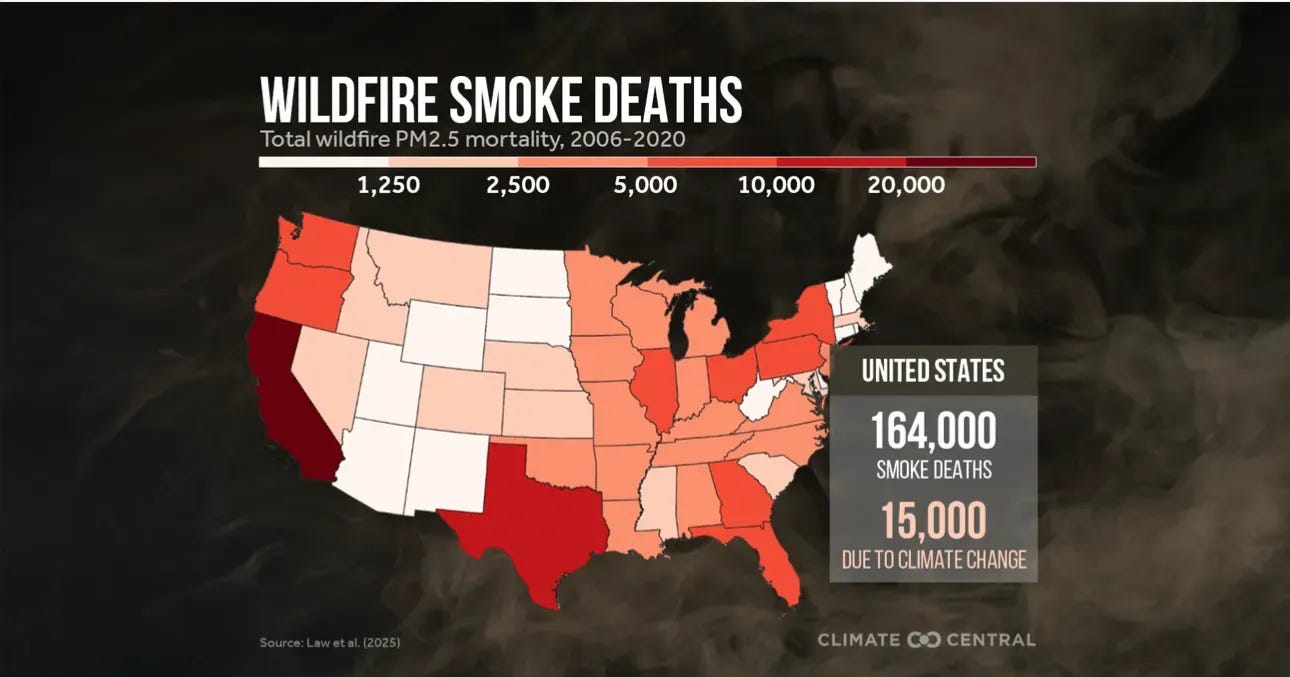
Source: Reproduced from Climate Change Worsens Wildfire Smoke, Climate Central (2025). https://www.climatecentral.org/climate-matters/climate-change-worsens-wildfire-smoke-2025
These converging crises reveal a broader lesson. Even societies, such as those in Western European and North American countries, possessing substantial scientific, financial, and institutional capacity increasingly find that traditional disaster-response models are insufficient for managing accelerating climate risks. They point toward a common imperative: strengthening resilience before disasters occur rather than relying primarily on reconstruction afterward.
The same lesson is increasingly relevant beyond Europe and North America. While Europe experienced record temperatures, the Copernicus Climate Change Service also reported record global ocean temperatures associated with a developing El Niño (C3S 2026b; C3S 2026c). Attention is therefore shifting toward the equatorial Pacific, where forecasts indicate that El Niño is likely to strengthen during the second half of 2026, posing significant risks to ecologically fragile regions, including Ecuador’s Galápagos Islands and the Pacific coastal regions of Ecuador and Peru.
In this note I focus on that second shock: what four decades of scientific observation tell us about El Niño’s impact on the Galápagos archipelago and in Ecuador at large, and what response measures should be put in place before the event arrives.
II. The Forecast for the Equatorial Pacific
As of 9 July 2026, the U.S. National Oceanic and Atmospheric Administration (NOAA) has officially declared that El Niño is underway. According to the NOAA Climate Prediction Center, the El Niño–Southern Oscillation (ENSO)—the natural climate cycle that alternates between the warm El Niño phase and the cool La Niña phase—is at El Niño Advisory, the status used when an event is already occurring rather than simply expected.
Forecasters monitor the strength of El Niño by measuring sea surface temperature (SST) anomalies—departures from the 1991–2020 climatological average—in several fixed regions of the equatorial Pacific. The most widely used indicator is the Niño-3.4 region (5°N–5°S, 170°W–120°W), where sustained positive SST anomalies are summarized by the Oceanic Niño Index (ONI). NOAA defines El Niño conditions when the three-month running mean SST anomaly in this region is at least +0.5°C for consecutive overlapping seasons and is accompanied by the characteristic atmospheric response (NOAA Climate Prediction Center 2026a, b; UCAR Climate Data Guide 2025). As of the latest weekly observations, the Niño-3.4 SST anomaly stood at approximately +1.2°C (NOAA Climate Prediction Center 2026a,b) (see Figure 2).
For the Galápagos the most important indicator is the Niño-1+2 region—a standardized ocean-monitoring area in the eastern equatorial Pacific that includes the waters off the Ecuadorian coast and around the Galápagos Islands. Scientists divide the tropical Pacific into several numbered regions (Niño-1+2, Niño-3, Niño-3.4 and Niño-4) to track where ocean temperatures are changing. Niño-1+2 is closest to Ecuador and the archipelago and therefore gives the best indication of the conditions that directly affect them. There, sea surface temperatures are already +2.7 °C above average—more than twice the anomaly in the central Pacific. This warming is closely associated with the weakening of the natural rise of cold, nutrient-rich deep water that fuels the Galápagos marine ecosystem (NOAA Climate Prediction Center 2026a, b).
The forward outlook is unusually firm. The NOAA Climate Prediction Center assigns a 97 percent probability that El Niño persists through early spring 2027, and an 81 percent probability of a very strong event during October–December 2026—an event that would rank among the largest in the historical record maintained since 1950 (NOAA Climate Prediction Center 2026a, b). The International Research Institute for Climate and Society (IRI) at Columbia University reaches essentially the same conclusion: based on its mid-July forecast, which combines the results of 26 independent climate models, every model projects that El Niño will persist throughout the forecast period, and 23 of the 26 predict that it will reach very strong intensity between October and December 2026 (IRI 2026).
This convergence of forecasts sends a clear call to action for governments, conservation organizations, and development partners to strengthen preparedness before El Niño impacts intensify. Seasonal forecasts remain probabilistic, and even the strongest El Niño does not produce its typical impact everywhere. But the disagreement among modelling centers that would normally justify waiting has largely been resolved. The case for moving into a preparatory phase no longer depends on settling a scientific dispute; it depends only on the willingness to act on a signal that is already unambiguous.
Figure 3: Niño-3.4 Anomaly, 2026–27 Compared with the Three Strongest El Niños on Record
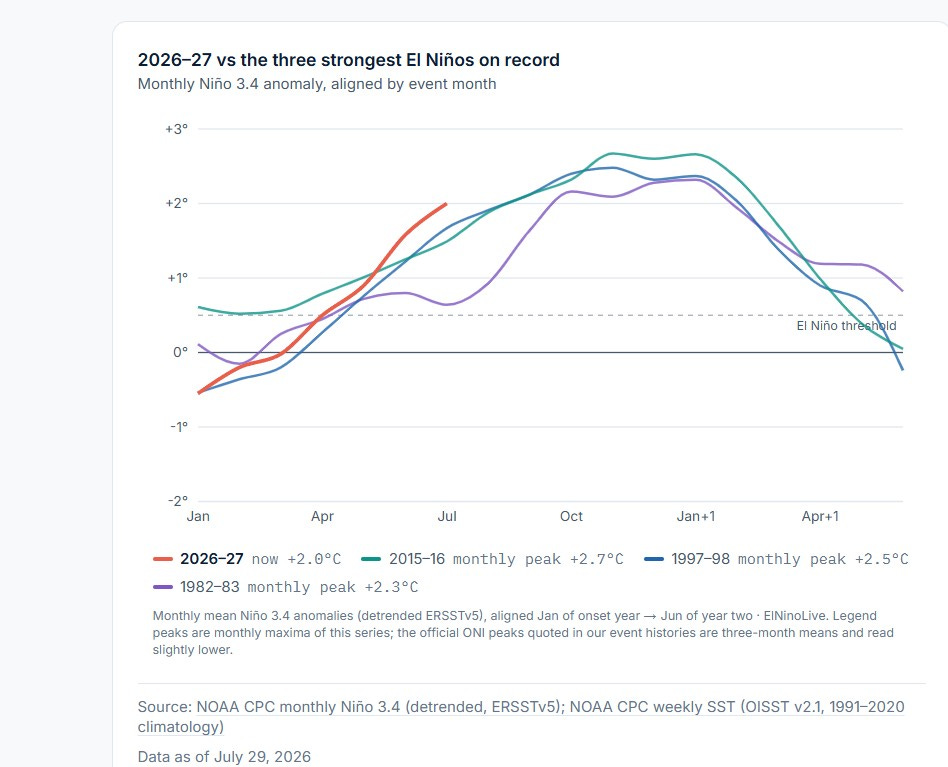
Source: Figure reproduced from ElNinoLive. (2026). El Niño in Peru and South America: Ground Zero, Then and Now. https://www.elninolive.com/impacts/south-america-peru
The developing El Niño has acquired broader significance in light of two important advances in contemporary climate science. Together, they suggest that the consequences of a major El Niño should no longer be viewed solely as temporary climatic disturbances but as events capable of interacting with a warming planet in ways that extend well beyond the duration of the event itself.
The first concerns the relationship between El Niño and global warming. Climate scientist James Hansen has argued that even a moderately strong El Niño during the next twelve to eighteen months could raise the global average temperature to approximately 1.7°C above the pre-industrial baseline, and that the Earth may not subsequently cool below the 1.5°C threshold established under the Paris Agreement (Berwyn 2026). Whether or not that specific threshold is permanently crossed remains the subject of scientific debate. The broader implication, however, is less controversial. Each successive El Niño now unfolds against a warmer climatic background than its predecessors, amplifying heat stress, drought, wildfire risk, heavy precipitation, and other climate-related hazards.
Crossing such thresholds should not be understood as triggering a single catastrophic rupture. Rather, it reflects the progressive transformation of climate systems that have historically fluctuated within relatively stable bounds. Forests, watersheds, rainfall regimes, and ocean ecosystems increasingly operate under conditions that differ from those experienced during earlier El Niño events. For policymakers, this distinction is important. It implies that historical analogues remain valuable but cannot be applied mechanically to future planning (Izurieta et al. 2026).
A second and particularly relevant advance comes from recent research examining the long-term consequences of super El Niño events. In a study published in Nature Communications, Xue et al. (2025) analyzed the three modern super El Niño events, 1982–83, 1997–98, and 2015–16, which they define as exceptionally intense El Niño episodes in which the normalized Niño-3 sea surface temperature anomaly during the mature phase (December–February) exceeds two standard deviations above normal.
Xue et al. (2025) found that super El Niño episodes of this magnitude can trigger climate regime shifts or persistent changes in regional climate systems that continue long after tropical Pacific sea-surface temperatures have returned to normal. Using observations together with climate-model simulations, the authors show that these shifts can alter surface air temperature, sea-surface temperature, precipitation, soil moisture, and atmospheric circulation, with effects persisting for years and, in some regions, even decades. Their simulations further indicate that the likelihood of such regime shifts is projected to increase under continued greenhouse warming (Xue et al. 2025).
The study also identifies several climate regime-shift hotspots. In the oceans, these include the central North Pacific, southeastern Indian Ocean, southwestern Pacific, and Gulf of Mexico. On land, prominent hotspots occur in East Africa and the Maritime Continent, while particularly strong soil-moisture responses are projected for central South Asia, central Australia, western Greenland, and the Amazon Basin (Xue et al. 2025; Berwyn 2026).
Although the eastern equatorial Pacific, including the Galápagos Islands, is not identified as one of the principal climate regime-shift hotspots, this finding should not be interpreted as diminishing concern for Ecuador. Rather, it underscores that the Galápagos faces a different category of risk: severe ecological disruption associated with exceptionally warm ocean temperatures and reduced marine productivity during strong El Niño events, rather than the long-lived post-event climate regime shifts identified by Xue et al. (2025). The well-documented responses of coral reefs, marine iguanas, Galápagos penguins, and other endemic species to previous extreme El Niño episodes remain a compelling basis for anticipatory action (Xue et al. 2025; Izurieta et al. 2026).
More broadly, the study offers an important lesson. The significance of a super El Niño lies not only in its immediate impacts but also in its potential to alter the environmental conditions upon which ecosystems and societies depend. As climatologist Jong-Seong Kug, senior author of the study, observed, a super El Niño “can shift the background climate conditions that people and ecosystems rely on” (Berwyn 2026). In other words, the consequences of an extreme El Niño may persist long after tropical Pacific sea-surface temperatures have returned to near-average conditions (Xue et al. 2025).
For Ecuador, the inclusion of the Amazon Basin among the regions exhibiting heightened susceptibility is particularly significant. It underscores that the implications of a super El Niño are not confined to the Pacific coast or the Galápagos Islands. Rather, they may extend across the country’s diverse ecological regions, influencing hydrological processes, soil moisture, biodiversity, agriculture, and human wellbeing on both sides of the Andes (Xue et al. 2025). This reinforces the need for preparedness strategies that recognize climate risks as interconnected across ecosystems rather than as isolated regional hazards.
The implications for the Galápagos are equally important, although of a different nature. The archipelago’s extraordinary biodiversity has evolved under relatively stable oceanographic conditions shaped by the convergence of major Pacific currents and persistent nutrient-rich upwelling. Strong El Niño events temporarily disrupt that stability by suppressing upwelling, reducing marine productivity, and triggering cascading effects throughout the food web. While Xue et al. (2025) do not identify the eastern equatorial Pacific as a principal climate regime-shift hotspot, their findings nevertheless reinforce the importance of considering the cumulative effects of increasingly intense El Niño events occurring against a warmer global climate. Under such conditions, recovery intervals between disturbances may shorten, potentially affecting ecosystem resilience, species interactions, and long-term conservation outcomes (Xue et al. 2025; Izurieta et al. 2026).
Figure 4: Drought in an El Niño Year
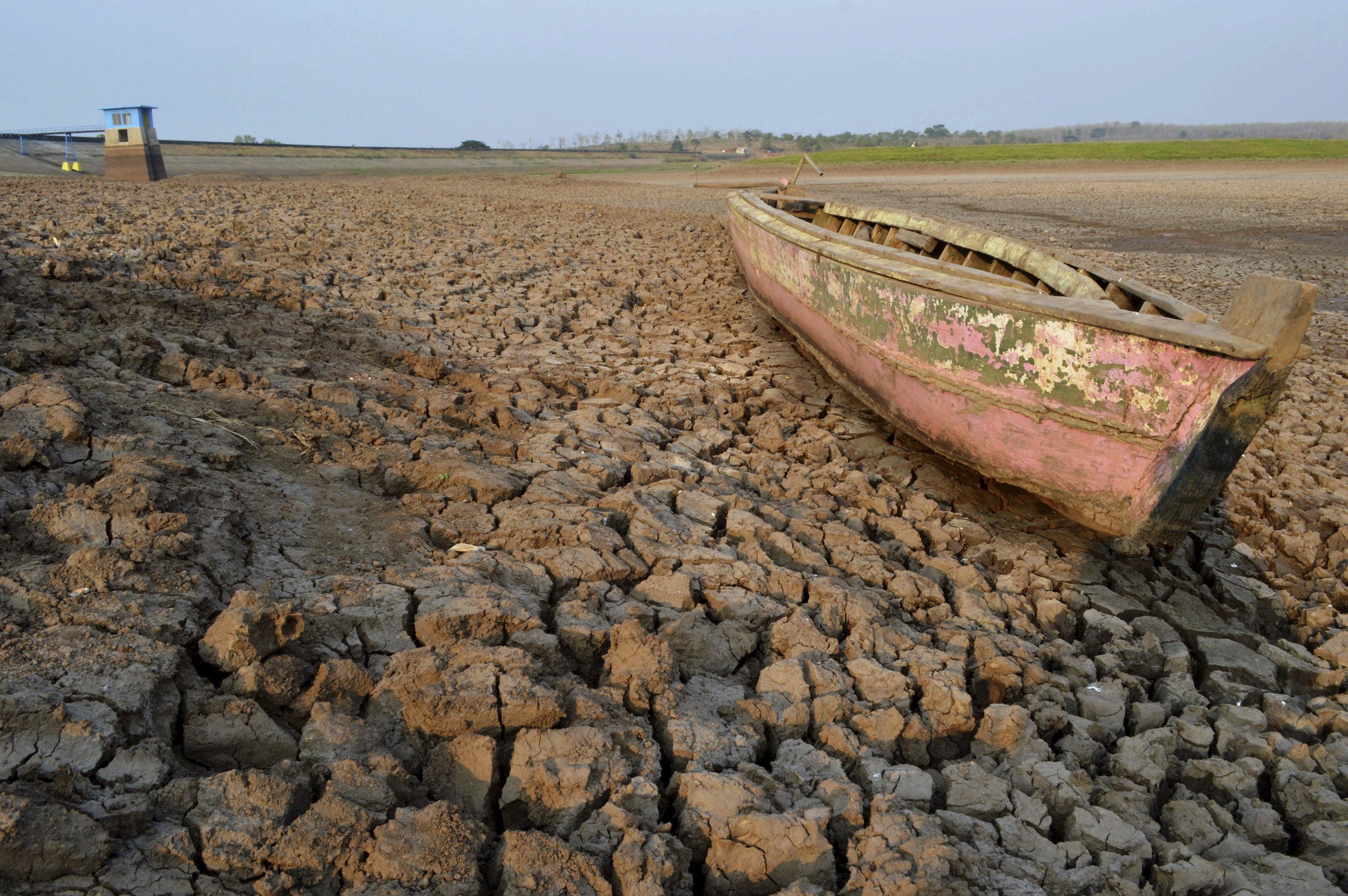
Note: A wooden boat is seen stranded on the dry cracked riverbed of the Dawuhan Dam during drought season in Madiun, Indonesia's East Java province. October 28, 2015. Photograph © ANTARA FOTO/Reuters/Corbis
Source: Reproduced from van Trotsenburg, A. (2015). We must prepare now for another major El Niño. https://blogs.worldbank.org/en/eastasiapacific/we-must-prepare-now-another-major-el-nino
The significance of these scientific findings is not that catastrophic outcomes are inevitable. Scientific uncertainty remains an inherent feature of climate forecasting, and neither seasonal predictions nor climate-model projections can determine precisely how individual ecosystems will respond. Rather, the evidence demonstrates that uncertainty should not be confused with inaction. On the contrary, the convergence of independent seasonal forecasts indicating a strengthening El Niño, together with growing evidence that super El Niño events can produce persistent climatic changes in vulnerable regions and that such risks increase under continued greenhouse warming, strengthens the case for anticipatory planning (IRI 2026; NOAA Climate Prediction Center 2026; Xue et al. 2025).
For the Galápagos Islands, this is more than an oceanographic forecast. It is an early warning that one of the world’s most distinctive ecosystems may soon experience one of its most severe recurrent natural disturbances under a warmer global climate than prevailed during previous major El Niño events. Although the archipelago is not identified as one of the principal climate regime-shift hotspots by Xue et al. (2025), its exceptional ecological sensitivity to ENSO-driven disruptions of ocean productivity is well established. The combination of increasingly warm baseline conditions, recurrent marine heat stress, and the prospect of another strong El Niño underscores the importance of strengthening ecological monitoring, protecting vulnerable species and habitats, and ensuring that institutional and financial preparedness measures are in place before impacts occur (Xue et al. 2025; Izurieta et al. 2026).
The appropriate response, therefore, is neither alarm nor complacency. It is informed preparedness—grounded in the best available science, supported by robust monitoring and early-warning systems, strengthened through effective institutions, and translated into anticipatory action before the next El Niño reaches its peak. That principle extends beyond the Galápagos. As recent research increasingly demonstrates, resilience depends not only on responding effectively to climatic shocks, but also on anticipating how a warming world may amplify their consequences and preparing accordingly.
III. What the Historical Record Shows
The ecological consequences of El Niño in the Galápagos follow a well-understood chain of events. Figure 5 illustrates the oceanographic processes that underpin these ecological impacts. The 1997–98 super El Niño dramatically altered sea-surface temperatures and ocean circulation across the tropical Pacific, disrupting the nutrient-rich upwelling that normally sustains the Galápagos Marine Reserve and one of the world's most productive marine ecosystems.
Figure 5: The 1997–98 El Niño’s Dramatic Impact on Ocean Biology
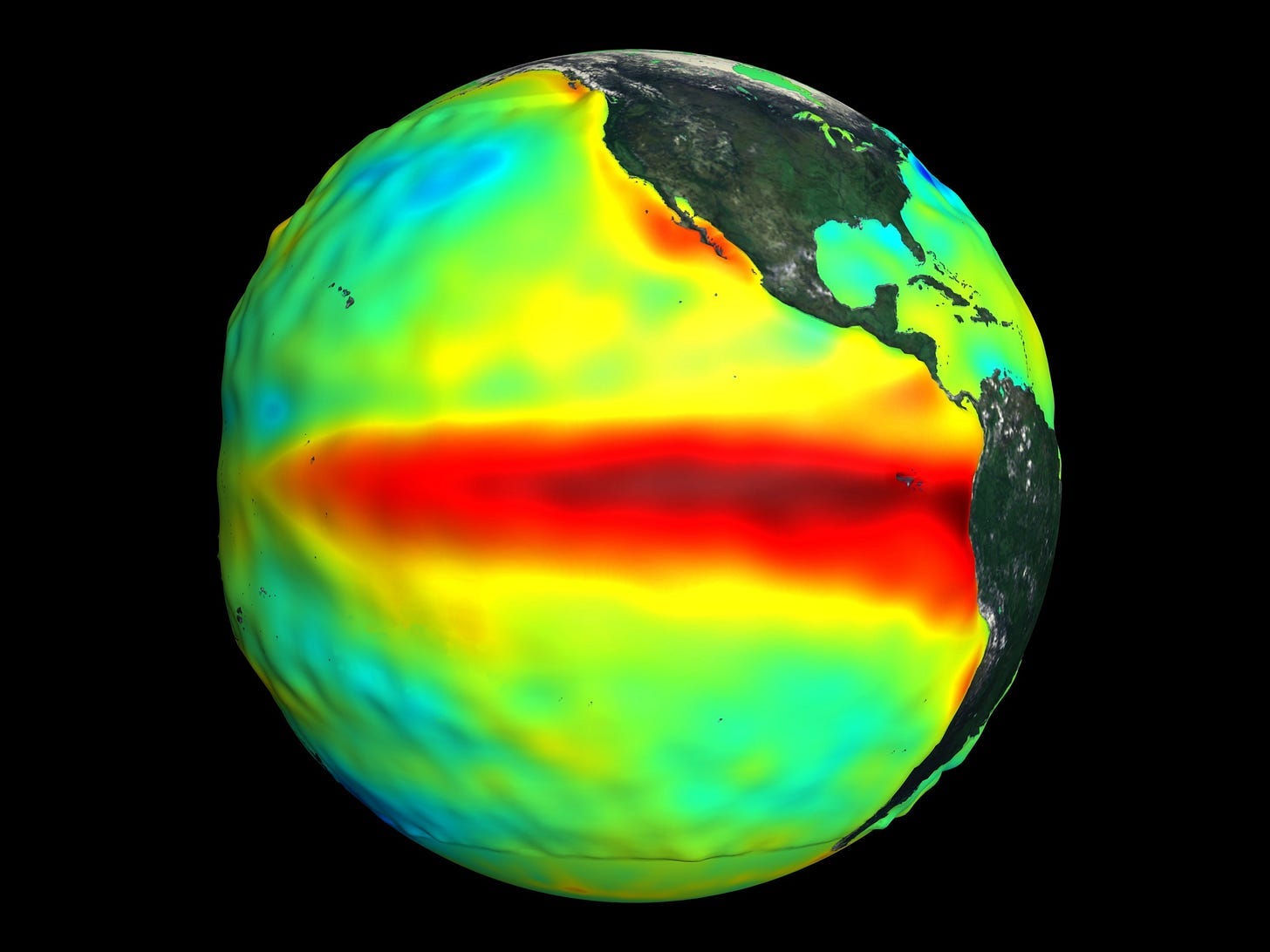
Note: The 1997-98 El Niño was truly a global event. The sequence shows a superposition of sea surface temperature anomalies on anomalies of the sea surface elevation. Warmer than normal temperatures are shown in red and cooler than normal temperatures are shown in blue.
Source: Reproduced from NASA Scientific Visualization Studio, n.d.
As the eastern Pacific warms, the normal flow of cold, nutrient-rich water from the deep ocean to the surface driven by the Cromwell Current and the Humboldt Current is greatly reduced. Without this continuous supply of nutrients, microscopic marine plants (phytoplankton), which form the base of the food web, decline sharply. Fish populations either migrate in search of cooler waters or suffer high mortality, and the seabirds and marine mammals that depend on them soon face food shortages.
The effects have been dramatic during the two strongest El Niño events on record. Marine iguanas (Amblyrhynchus cristatus), which feed almost exclusively on marine algae, lost as many as 70 percent of individuals in some colonies during the 1982–83 event. During the 1997–98 El Niño event, catalogued as the strongest of the 20th century, surpassing the anomalies and impacts associated with the 1982-83 event, mortality reached 90 percent on some islands (Steinfartz et al. 2007; Galápagos Conservancy 2024). On Genovesa Island alone, the population fell from roughly 15,000 individuals to only 900 in a single El Niño cycle (Wikelski and Nelson 2004; Steinfartz et al. 2007).
Galápagos penguins (Spheniscus mendiculus) experienced equally severe declines. Their population fell by 77 percent during the 1982–83 event and by 65 percent during 1997–98. More than two decades later, the species has still not fully recovered, helping explain its current classification as endangered (Galápagos Conservancy n.d; Steinfartz et al. 2007; Wikelski and Nelson 2004; Xue et al. 2025; Galápagos Conservation Trust 2023).
Other marine wildlife responds in similar ways. Sea lions, flightless cormorants, boobies, and frigatebirds frequently suspend breeding during severe El Niño events because food becomes too scarce to raise young successfully. Among sea lions, mortality is especially high among pups and dominant breeding males (Galápagos Conservancy 2024; Xue et al. 2025; Steinfartz et al. 2007; Wikelski and Nelson 2004; and Izurieta et al. 2026).
Perhaps the clearest example of the long-term ecological consequences comes from the coral reefs. The 1982–83 El Niño destroyed approximately 97 percent of Galápagos coral cover. Four decades later, those reefs have still not recovered, leaving the few remaining coral communities among the ecosystems most vulnerable to another extreme El Niño (Robinson and del Pino 1985; Charles Darwin Foundation 2024a).
Not all impacts are negative. On land, the heavier rains associated with El Niño stimulate plant growth that benefits giant tortoises, land iguanas, and Darwin’s finches. Yet those same wet conditions also favor invasive species. Fire ants, blackberry, guava, and invasive rodents expand rapidly during and immediately after El Niño years, increasing competition with native species and hindering conservation efforts (Charles Darwin Foundation 2024b). Thus, the same rains that temporarily benefit some native wildlife also strengthen one of the archipelago’s greatest long-term threats.
Figure 6 places these ecological impacts in their geographical context by identifying the principal long-term monitoring sites across the Galápagos Marine Reserve. These locations form the core of the archipelago's ecological surveillance system, providing the baseline information needed to detect changes in coral reefs, marine iguana populations, and Galápagos penguins as El Niño conditions develop.
These historical comparisons are instructive, but they should not be read as a blueprint for what will happen in 2026–27. Izurieta et al. (2026) caution against mechanically extrapolating either the ecological impacts or the policy lessons of the 1982–83 and 1997–98 events to the present. They argue that the context has changed in important ways, and not all of those changes point in the same direction.
On the one hand, several factors increase the archipelago’s vulnerability. Long-term climate change has raised the ocean’s thermal baseline, meaning that the same El Niño anomaly now occurs in a warmer sea. At the same time, decades of growing tourism, fishing pressure, and the establishment of invasive species have reduced the ecological buffer that helped absorb earlier shocks. Plastic pollution, which was negligible during the 1982–83 event and only a marginal concern in 1997–98, has become an additional stressor (Marquez 2019). It now harms seabirds and marine organisms directly, while warmer waters and stronger wave action accelerate the formation and dispersal of microplastics during El Niño conditions (Izurieta et al. 2026).
Figure 6. The Galápagos Islands and principal ecological monitoring sites.
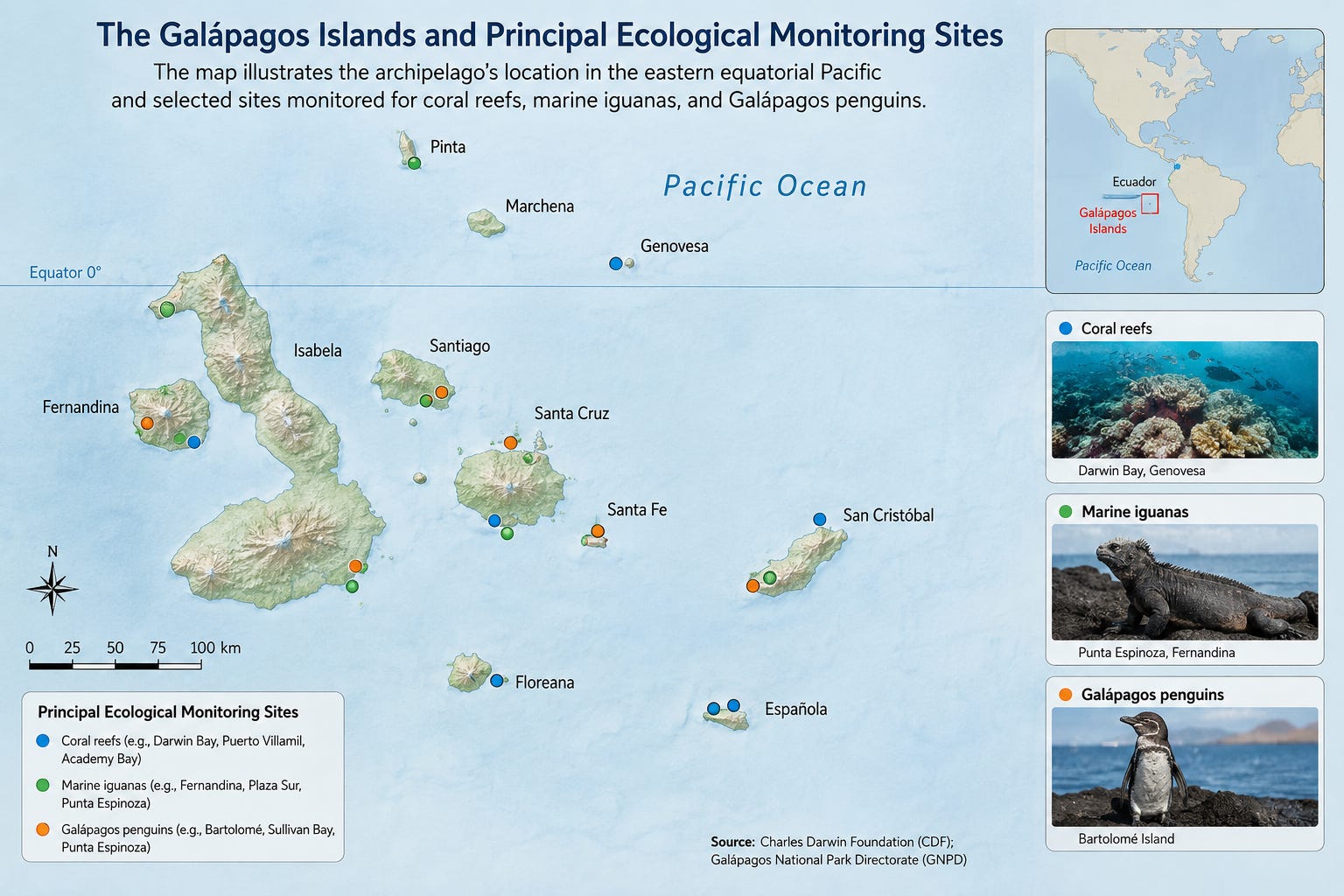
The map illustrates the archipelago’s location in the eastern equatorial Pacific and selected sites monitored for coral reefs, marine iguanas, and Galápagos penguins.
Source: Charles Darwin Foundation; Galápagos National Park Directorate.
On the other hand, Ecuador enters this event better prepared than it did three decades ago. Scientific monitoring is more sophisticated, conservation institutions are stronger, and the country now has access to financing and emergency response mechanisms that did not exist during previous ENSO cycles. The challenge, therefore, is not simply greater risk, but greater risk alongside greater capacity to respond.
Izurieta et al. (2026) make an important point that deserves emphasis: El Niño should not be viewed simply as a disaster. It is a major ecological disturbance that produces both losses and opportunities, with impacts that vary across species and ecosystems. Increased rainfall, for example, can improve breeding success for some terrestrial species, alter species distributions, and create opportunities for new colonization. The appropriate way to understand El Niño is therefore as an ecological disturbance with uneven and often contrasting consequences, rather than as a uniformly catastrophic event.
This broader perspective, however, does not diminish the central conservation concern. For the Galápagos’ most vulnerable species—including the marine iguana, the Galápagos penguin, the flightless cormorant, the waved albatross, the Galápagos fur seal, and shallow-water coral and invertebrate communities—the risk of severe population declines and, in some locations, local extinction during a strong 2026–27 El Niño remains real (Izurieta et al. 2026).
The Charles Darwin Foundation has been equally clear about these concerns. Its Executive Director, Rakan Zahawi, has described witnessing the increasing frequency and intensity of ENSO-related disruptions and the additional pressures they bring, particularly the expansion of invasive species that threaten the ecosystems the Foundation was established to protect (Climate Fund Managers 2024).
A substantial body of modelling research suggests that greenhouse warming is likely to increase the frequency of extreme El Niño events and the variability of eastern Pacific events (Cai et al. 2014; Cai et al. 2018). The Intergovernmental Panel on Climate Change (IPCC 2021), however, concludes that there is still no scientific consensus that El Niño events themselves will become systematically stronger. Similarly, the World Meteorological Organization notes that there is no clear evidence that climate change is increasing the frequency or intensity of El Niño events, while emphasizing that a warmer ocean and atmosphere amplify the impacts those events produce (WMO 2026a, WMO 2026b).
The practical implication is straightforward. Scientists continue to debate how El Niño itself may evolve in a warming world. They do not debate that when a strong El Niño occurs, its impacts unfold on a warmer, more stressed, and more vulnerable planet. That distinction is critical. It reinforces the case for acting on today’s evidence rather than waiting for tomorrow’s certainty.
IV. Human Systems Are Not a Separate Emergency
Discussions of El Niño frequently emphasize its ecological consequences because they are immediate and highly visible. Yet the same climatic forces that disrupt marine and terrestrial ecosystems simultaneously expose vulnerabilities within human systems that ultimately determine both the effectiveness of conservation efforts and the resilience of affected communities. Public health, water and sanitation, transportation, education, tourism, fisheries, agriculture, and local economies are all affected as environmental disturbances cascade through interconnected ecological, social, and economic systems. Protecting biodiversity and protecting people are therefore complementary rather than competing objectives.
Ecuador's experience during the 1997–98 El Niño offers a good illustration of this interdependence. While the event caused extensive ecological damage, it also generated a multisector development challenge requiring coordinated action across public health, infrastructure, environmental management, social protection, and fiscal policy.
A. Public Health Impacts
Public health is not a secondary consequence of a major El Niño. It is a parallel emergency, and it arrives on the same schedule.
World Bank climate and health analyses have documented that ENSO events in Latin America affect human wellbeing through at least five interconnected pathways (World Bank 2017, 2018):
Increased vector-borne disease risk as changes in temperature and rainfall alter mosquito ecology.
Increased waterborne disease following floods that compromise drinking water and sanitation systems (see Figure 7 below).
Food insecurity and malnutrition arising from losses in agriculture, livestock, and fisheries.
Disruption of essential health services caused by damage to health facilities, communications failures, and interruptions in medicine supply chains.
Displacement-related health risks, including communicable diseases, maternal and child health challenges, and psychosocial impacts associated with population displacement.
These pathways are mutually reinforcing rather than independent. Ecological disruption rapidly translates into public health challenges, while weaknesses in health systems amplify the human consequences of environmental shocks (Marquez 2022a; Marquez 2022b; Marquez 2023).
Regional analyses of malaria and dengue between 1996 and 2006 identified the 1997–98 El Niño as a period of elevated disease transmission across Latin America and demonstrated that temperature increases of only 1–2°C can alter transmission dynamics in equatorial ecosystems such as the Peruvian Amazon (World Bank 2010, 2014). The operational implications for Ecuador—and particularly for the Galápagos—are therefore clear. El Niño preparedness must extend beyond environmental conservation and infrastructure protection. It also requires strengthening epidemiological surveillance, laboratory and vector-monitoring capacity, safe water and sanitation, resilient primary health care services, emergency logistics, and continuity plans that ensure essential health services remain operational during floods and population displacement.
Figure 7. Flooding in Guayaquil during the 1997–98 El Niño.
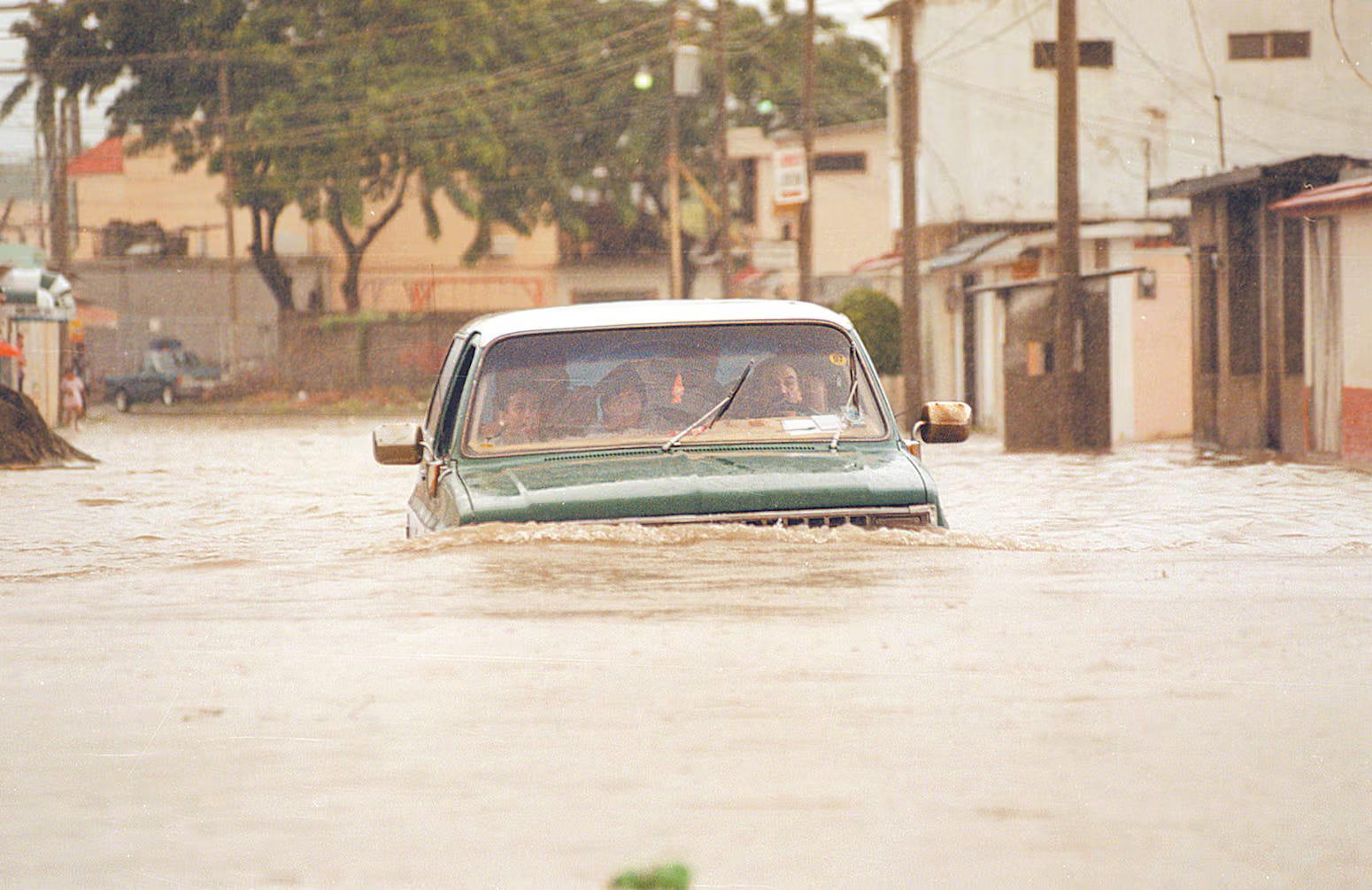
Source: El Universo (2023), “¿Cómo afectó el fenómeno de El Niño de 1997 y 1998 al Ecuador?” [How Did the 1997–1998 El Niño Affect Ecuador?], including the archival photograph “Inundaciones en la ciudad de Guayaquil por el fenómeno de El Niño” [Flooding in the City of Guayaquil Caused by the El Niño Phenomenon], photograph taken February 19, 1998.
B. Learning from Ecuador’s Health Response to the 1997–98 El Niño
Ecuador’s health response to the 1997–98 El Niño provides a relevant historical precedent for the preparedness challenges the country faces today. I write about this experience not as an observer, but as an active participant. The response demonstrated that acting early and effectively does not always depend on new funding. By adapting existing development operations and reallocating available resources, Ecuador was able to launch a quick response while additional financing and broader recovery efforts were being mobilized (World Bank 1997b; World Bank 1999).
From 1992 to 1999, I served as the World Bank Task Manager for the Ecuador Second Social Development Project—Health and Nutrition (FASBASE), a US$102 million operation designed to expand access to essential health, nutrition, and water and sanitation services for Ecuador’s poorest and most vulnerable populations (World Bank 1992). The project was prepared in 1992 under Dr. Plutarco Naranjo, Minister of Public Health in the Rodrigo Borja administration, and began implementation as the Sixto Durán-Ballén government took office in August of that year. Although conceived as a long-term social development operation, FASBASE proved sufficiently flexible to become the principal vehicle for the health-sector response when the 1997–98 El Niño struck. In doing so, it demonstrated how well-designed development operations can be adapted rapidly to address emerging crises while maintaining their longer-term development objectives (World Bank 1999).
As the impacts of El Niño intensified, Ecuador did not wait for additional emergency financing before acting. Between November 1997 and June 1999, approximately US$12 million was reallocated within the existing FASBASE operation under a health-sector contingency plan led by Dr. Guillermo Wagner and Dr. Asdrúbal de la Torre, successive Ministers of Public Health, and their teams during the Fabián Alarcón administration (World Bank 1999). These resources financed health services for displaced populations and residents of temporary shelters across the coastal provinces of Guayas, Los Ríos, El Oro, Manabí, and Esmeraldas. They also supported intensified epidemiological surveillance, malaria and dengue prevention and control, vector control, essential medicines and medical supplies, emergency public health interventions, nutrition support, and other measures designed to prevent communicable disease outbreaks in communities affected by flooding and population displacement (World Bank 1999).
Additional financing followed once the full scale of the crisis had become clear. In September 1999, the World Bank approved a US$20.2 million Supplemental Loan, prepared under Dr. Edgar Rodas, Minister of Public Health, and his team during the Jamil Mahuad administration (World Bank 1999). By then, the devastation caused by El Niño had been compounded by collapsing oil export prices and the international financial crisis, while reported malaria cases had exceeded 45,000 during the first half of 1999 alone. The supplemental operation sought not only to restore essential health services but also to strengthen resilience through nutrition programs, water and sanitation interventions, and a dedicated US$2.9 million malaria prevention and control program serving approximately two million people in 42 high-risk cantons. Its integrated approach combined community participation, strengthened laboratories and local health facilities, early diagnosis and prompt treatment, insecticide-treated bed nets, disease surveillance, and environmental management. Notably, after assessing costs and benefits, the operation deliberately chose not to finance synthetic chemical pesticides, relying instead on biological and environmental approaches to vector control (World Bank 1999).
Looking back nearly three decades later, the principles underpinning this health-sector response remain strikingly relevant. The strategy emphasized acting early rather than waiting for the crisis to deepen, integrating public health, nutrition, water and sanitation, and vector control instead of treating them as separate interventions, decentralizing implementation to local health services, and placing communities at the center of prevention and response. Together, these principles continue to define climate-resilient health systems and anticipate many of the elements that today underpin the One Health approach, including integrated surveillance, environmental management, and community-based prevention (World Bank 2018; Marquez 2022a).
The rapid adaptation of FASBASE and the subsequent mobilization of additional health-sector financing were not isolated interventions. They formed part of a broader national effort in which the Government of Ecuador, supported by the World Bank and other development agencies, launched a multisectoral emergency recovery program to reduce the loss of human life and livelihoods, protect and rehabilitate economic and social infrastructure damaged by flooding and heavy rainfall, and strengthen the country’s capacity to forecast and respond to future El Niño events (World Bank 1997b). This emergency recovery operation complemented sector-specific actions already underway in health, social protection, transport, water supply, agriculture, and other sectors, demonstrating the value of combining flexible sectoral programs with dedicated emergency financing to address a complex climatic crisis.
C. From Lessons Learned to Integrated Preparedness
Ecuador’s response demonstrated that resilience is built before disasters reach their peak. Institutional flexibility, integrated planning, decentralized implementation, and effective coordination proved as important as emergency financing itself. Environmental disturbances rapidly cascade through interconnected ecological, social, economic, and institutional systems, transforming environmental shocks into multidimensional development challenges.
These cascading impacts underscore that the conservation challenge is inseparable from the development challenge. Healthy ecosystems, resilient livelihoods, sustainable public finances, and effective health systems are mutually reinforcing components of a single socioecological system. This integrated perspective increasingly underpins the World Bank’s work on climate resilience, disaster risk management, and Small Island Developing States (World Bank 2017, 2024a, 2025e).
It is equally applicable to the Galápagos, where tourism and fisheries depend directly on healthy ecosystems. Severe El Niño events simultaneously reduce marine productivity, disrupt wildlife populations, damage infrastructure through heavy rainfall, and diminish the visitor experience. Artisanal fishers lose access to key commercial species precisely when coastal communities become more dependent on them for income, while demand for social services rises just as public revenues and household livelihoods come under increasing pressure. For an archipelago whose two principal settlements, Puerto Ayora and Puerto Baquerizo Moreno, already experience pressure on water, sanitation, and waste-management systems under normal conditions (Marquez 2024), the inclusion of these services cities in a response program is far from incidental.
The lesson is clear: adaptation strategies that address ecological, economic, fiscal, or public health risks in isolation are unlikely to achieve lasting resilience because each depends on the others. Effective preparedness requires integrated planning that recognizes the interdependence of environmental sustainability, economic resilience, public health, and institutional capacity.
Viewed from today’s perspective, the response anticipated many principles that now underpin anticipatory action: adaptive implementation, multisectoral coordination, rapid repurposing of financing, and the capacity to act on emerging risks before additional resources become available.
As climate-related disasters become more frequent and severe, these principles remain highly relevant—not only for Ecuador as it prepares for the potential impacts of the developing 2026–27 El Niño, but also for other countries seeking to strengthen resilience before future shocks occur (UNEP 2025).
Table 1 synthesizes these operational lessons and provides the empirical foundation for the integrated anticipatory resilience framework developed in Section V.
Table 1: Lessons from Previous El Niño Events
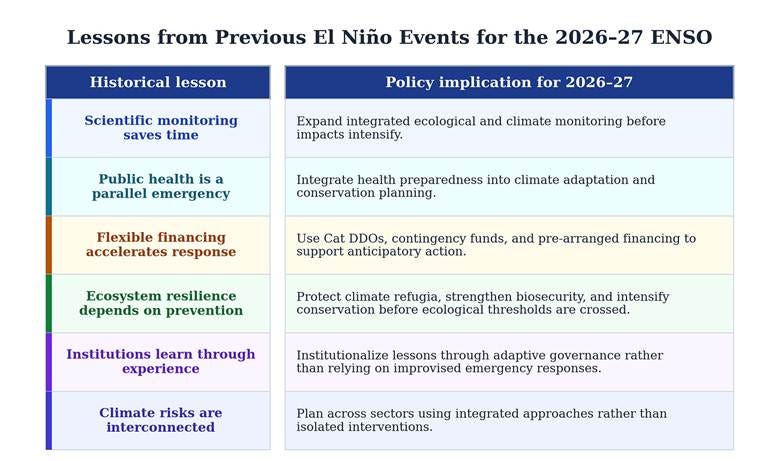
Source: Elaborated by Patricio V. Marquez (2026) for this note. Synthesis based on World Bank (1999, 2000, 2017, 2026); Charles Darwin Foundation (2024a, 2024b); Galápagos Conservancy (2024); Galápagos Conservation Trust (2023); Izurieta et al. (2026); and sources cited throughout this paper.
V. From Reactive Response to Anticipatory Resilience
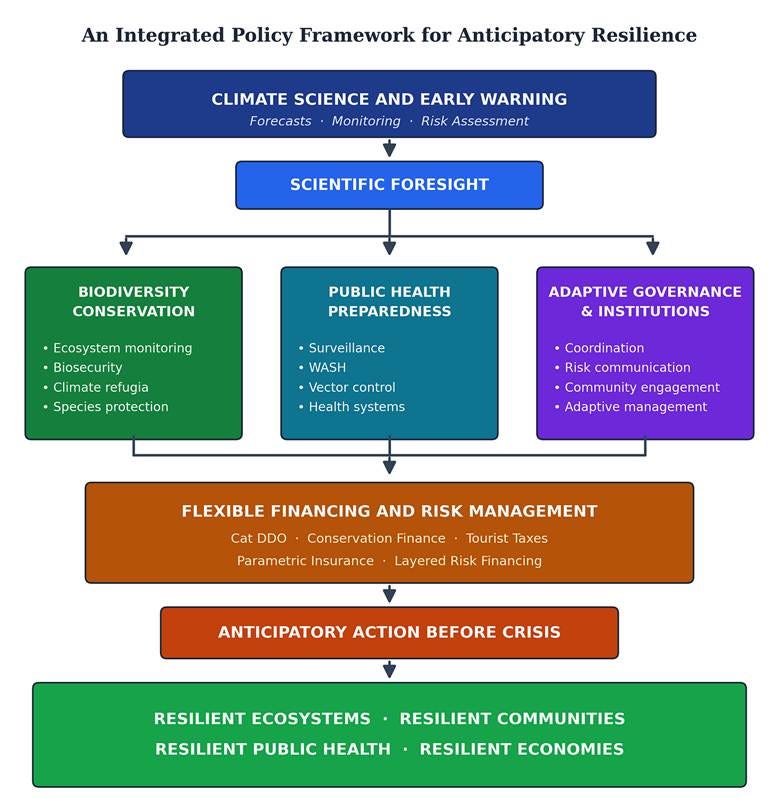
The central proposition advanced in this note is that climate resilience should be understood not primarily as the capacity to recover after disasters occur, but as the capacity of institutions to anticipate risks, reduce vulnerability before ecological and social thresholds are crossed, and mobilize coordinated action while there is still time to influence outcomes.
Figure 8 presents the integrated anticipatory resilience framework proposed in this note, illustrating how climate forecasting and scientific monitoring, ecological stewardship, public health preparedness, adaptive governance, and innovative financing function as mutually reinforcing components of a single socioecological system. The framework is conceptual and illustrates the institutional relationships through which these components interact to strengthen anticipatory resilience before climate shocks evolve into ecological, public health, and socioeconomic crises.
Figure 8:
Source: Elaborated by Patricio V. Marquez (2026) for this note. Synthesized from World Bank (1999, 2000, 2017, 2025a, 2025b, 2026); UNEP (2025); Cai et al. (2014, 2018); Izurieta et al. (2026); and other sources cited throughout this paper.
A. Building the Institutional and Financial Architecture
Scientific knowledge and institutional preparedness are necessary but insufficient without timely financing. Modern disaster-risk financing instruments—including contingent financing, Cat DDOs, parametric insurance, conservation finance, and dedicated resilience funds—should be viewed as complementary components of a layered institutional architecture supporting anticipatory action.
For the Galápagos, strengthening ecological monitoring, establishing pre-event baselines, reinforcing biosecurity, protecting ecological refugia, and linking financing to operational preparedness are essential elements of anticipatory resilience.
Three decades of institutional learning underpin this approach. The 1997–98 El Niño prompted World Bank emergency operations in Peru, Ecuador, and Bolivia that began shifting disaster management from post-disaster reconstruction toward prevention, forecasting, and preparedness (World Bank 1997a, World Bank 1997b; World Bank 1998). A subsequent World Bank study concluded that improved forecasts create value only when institutions can convert information into timely action (World Bank 2000). Later assessments done by the World Bank’s Independent Evaluation Group reinforced this lesson by emphasizing the importance of pre-trained personnel, simplified procurement procedures, retroactive financing for preventive investments, and contingent financing for recovery (Independent Evaluation Group 2022).
By 2025–26, this evolution had crystallized into a new generation of financing instruments. The World Bank’s disaster risk financing toolkit now includes Development Policy Financing with Catastrophe Deferred Drawdown Options (Cat DDOs), Contingent Emergency Response Components (CERCs), catastrophe-risk insurance and catastrophe bonds, the Rapid Response Option (RRO), and climate-resilient debt clauses—mechanisms that integrate financing into preparedness and resilience rather than treating it solely as a source of post-disaster assistance (World Bank 2025a; World Bank 2025b; World Bank 2025c; World Bank 2025d; World Bank 2025f).
For Ecuador, this institutional foundation is stronger than at any previous point in the ENSO cycle. On 26 November 2025, the World Bank’s Board of Executive Directors approved Ecuador’s first US$200 million Disaster Risk Management Development Policy Financing with a Catastrophe Deferred Drawdown Option (Cat DDO) (World Bank 2025b). The operation is designed to strengthen the country’s capacity to manage climate, geophysical, and public health risks while incorporating disaster preparedness, disease control, health security, health-system strengthening, biodiversity protection, and One Health approaches into its policy framework, thereby providing immediate contingent financing should a major disaster or public health emergency occur.
B. Anticipatory Response and Financing in the Galápagos
Against this backdrop, five clusters of action in the Galápagos deserve priority before El Niño reaches its projected peak.
First, the Charles Darwin Foundation's long-term subtidal ecological monitoring program already provides a strong foundation for anticipatory action. Across the Galápagos Marine Reserve, it tracks coral health using large-area imagery and oceanographic data to identify sites most vulnerable to ENSO and improve the capacity to anticipate ecological impacts (Charles Darwin Foundation 2024a; Izurieta et al. 2026). However, the opportunity to establish robust pre-event baselines for coral reefs, marine iguana colonies, and Galápagos penguin populations is rapidly narrowing as sea-surface temperatures continue to rise. That window should extend landward as well. Recent conservation gains, as observed by Standford University Professor, William H. Durham (2026), are the most reversible: native terrestrial species recovering under sustained invasive control — among them the Galápagos rail (Laterallus spilonotus) and the Scalesia tree species — warrant explicit listing among the biota in greatest danger, with mortality and reproductive performance tracked through the event. Recognizing that monitoring effort is finite, a short sentinel list of such species is preferable to archipelago-wide terrestrial coverage. Locking in these baselines — marine and terrestrial — through Q3 2026 is the foundation on which post-event quantification, attribution, and recovery planning depend.
Second, invasive-species containment as climate adaptation through strengthened biosecurity, surveillance, and rapid response before the expected increase in invasive pressures associated with wetter conditions (GEF 2024; Izurieta et al. 2026).
Third, protection of ecological refugia, particularly western Isabela and Fernandina, where persistent upwelling has historically buffered marine ecosystems during strong El Niño events and facilitated post-event recovery (Houvenaghel 1984; Snell and Rea 1999; Izurieta et al. 2026).
Fourth, climate disaster-risk financing linked to Ecuador’s Cat DDO (World Bank 2025b; World Bank 2025f). Ecuador’s newly approved Cat DDO provides a pre-arranged contingent line of credit that becomes immediately available once the government declares an eligible natural, climate-related, or public health emergency. Unlike conventional reconstruction loans, which are negotiated after a disaster has occurred, a Cat DDO is approved in advance and can be rapidly disbursed to provide liquidity during the critical first days or weeks of a crisis while additional domestic and international financing is mobilized (World Bank 2025b; World Bank 2026). The instrument therefore reduces delays in emergency response and supports governments in maintaining essential public services when fiscal pressures are greatest.
A possible next step for the Galápagos would be to complement this sovereign contingent credit with a Galápagos-specific parametric insurance mechanism. Unlike traditional indemnity insurance, which requires field assessments to estimate actual losses before compensation can be paid, parametric insurance is triggered automatically when predefined physical thresholds are exceeded. These triggers could include, for example, sustained anomalies in Niño 3.4 or Niño 1+2 sea-surface temperatures, exceptionally high sea-surface temperatures around the archipelago, extreme rainfall, or other scientifically validated indicators associated with severe El Niño impacts. Once those agreed thresholds are reached, payouts would be released automatically according to pre-established formulas, eliminating lengthy damage assessments and allowing funds to become available within days rather than months (World Bank 2025a; GFDRR 2025).
Such a mechanism could be linked to pre-arranged disbursement protocols agreed before the onset of an event. Rather than entering the general government budget, payouts could flow through predetermined allocation channels to finance specific emergency activities undertaken by entities such as the Galápagos National Park Directorate, the Charles Darwin Foundation, the Galápagos Life Fund, the Ministry of Public Health, and local emergency management authorities. Eligible expenditures could include intensified ecological monitoring, rapid invasive-species control, emergency wildlife rescue and rehabilitation, continuity of health services, epidemiological surveillance, vector control, laboratory diagnostics, emergency water and sanitation measures, and the repair of critical conservation and public-health infrastructure. Establishing these allocation rules before an event would minimize administrative delays and ensure that resources reach operational agencies when they are needed most.
Viewed together, Ecuador’s Cat DDO, a future Galápagos parametric insurance facility, catastrophe bonds, and other disaster-risk financing instruments would constitute a layered financial protection strategy. The first layer would consist of regular government budgets and reserve funds; the second would provide rapid contingent liquidity through the Cat DDO; the third would transfer the financial consequences of extreme, low-probability events to insurance and capital markets through parametric insurance and catastrophe bonds. This layered approach enables governments to match financing instruments to different levels of disaster risk, ensuring that predictable, moderate, and catastrophic losses are financed through the most appropriate mechanisms while reducing fiscal disruption and accelerating recovery (World Bank 2025a; GFDRR 2025).
Fifth, sustained conservation finance through innovative mechanisms such as the Galápagos debt conversion, the Galápagos Life Fund, PROBLUE, and the World Bank’s Global Program on Nature-Based Solutions. Together, these initiatives demonstrate how long-term financing can become an integral component of ecosystem resilience rather than simply a source of post-disaster recovery (DFC 2023; World Economic Forum 2023; World Bank 2024b; World Bank 2025e; World Bank 2025g).
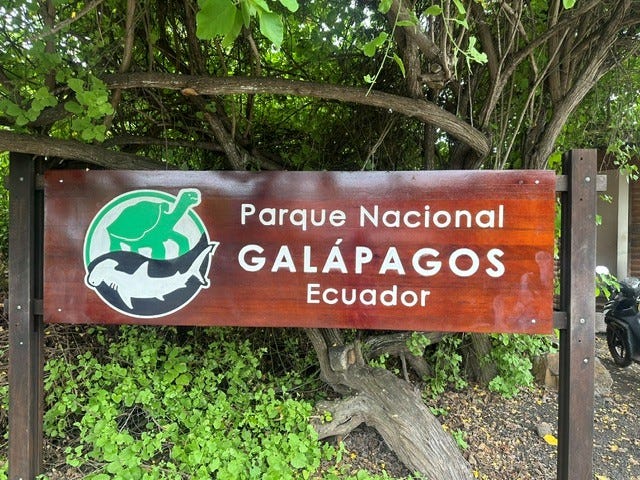
Connected to these international instruments are revenue mechanisms embedded within Ecuadorian fiscal policy arrangements. The 2024 increase in the Galápagos National Park entry fee from USD 100 to USD 200—the first adjustment since 1998, which I previously analyzed as an example of tourist taxation for financing public goods (Marquez 2026a), creates a new revenue stream that could, in part, be earmarked for an El Niño contingency reserve. Such a reserve could provide pre-committed financing for emergency wildlife interventions, accelerated invasive-species response, continuity of essential health services, and rapid repair of critical infrastructure. If adopted, this would represent another example of a “win-win-win” policy approach: generating sustainable financing from tourism while simultaneously strengthening biodiversity conservation, public health preparedness, and climate resilience.
The concept is not new. For example, the World Bank’s pro-health taxation program, which I led between 2014 and 2019 with support from Bloomberg Philanthropies and the Bill & Melinda Gates Foundation, was established following the same principle (Marquez and Moreno-Dodson 2017): increasing taxes and prices on tobacco products to reduce consumption and its associated health risks, improve public health, reduce environmental pollution, and generate additional public revenue to finance priority investments benefiting society as a whole.
The same logic applies to climate resilience in the Galápagos. Financing mechanisms should generate resources from activities that place pressure on fragile ecosystems and reinvest those resources in protecting biodiversity, strengthening public health systems, and building resilience before the next El Niño or other climate shock arrives. This preventive, risk-based philosophy also underpins the World Bank’s work on the blue economy and disaster-risk financing (World Bank 2025a; World Bank 2025f).
Figure 9:

Source: Photos by author, Puerto Ayora, Santa Cruz Island, Galapagos, June 2026.
C. A Good Practice in Anticipatory Conservation
Financing alone cannot build resilience. Equally important is the capacity of institutions to translate scientific knowledge, technological innovation, and multi-sector partnerships into preventive conservation before ecological thresholds are crossed. Increasingly, conservation initiatives around the world demonstrate that the most effective responses are those that anticipate ecological risks rather than reacting after irreversible losses have occurred. These experiences offer valuable lessons for the Galápagos as it prepares for another major El Niño event.
One particularly instructive example is the collaborative effort to conserve the pronghorn (Antilocapra americana) in California’s Carrizo Plain (Barkats 2026). The pronghorn is North America’s fastest land mammal—capable of reaching speeds approaching 60 miles (97 km) per hour—and the sole surviving representative of an ancient mammalian lineage dating back to the Pleistocene era. Often regarded as an indicator of the ecological integrity of North America’s remaining native grasslands, the species has experienced a dramatic decline in the Carrizo Plain, where fewer than 60 individuals remain as a consequence of prolonged drought, climate change, habitat fragmentation, roads, and conventional livestock fencing (Barkats 2026).
Rather than waiting until the population reaches the point where emergency recovery measures become the only option, conservation partners have adopted an anticipatory management strategy. The initiative brings together The Nature Conservancy, the California Department of Fish and Wildlife, California Polytechnic State University (Cal Poly), local ranchers, and artificial intelligence developers working through the open-source ANIML platform (Barkats 2026). This partnership integrates ecological science, technological innovation, private land stewardship, and public-sector leadership to reduce climate-related risks before they translate into irreversible biodiversity losses.
Preventive actions under the California’s Carrizo Plain initiative include: restoring habitat connectivity through wildlife-friendly fencing; replacing conventional cross-fencing with GPS-enabled virtual fencing systems in which cattle wear satellite-linked collars that respond to digital boundaries rather than physical barriers; removing or reducing unnecessary physical fencing to improve wildlife movement and landscape connectivity; expanding strategically located water sources to increase drought resilience; applying artificial intelligence to ecological monitoring and wildlife surveillance; and working collaboratively with ranchers to improve landscape management while maintaining productive agricultural systems (Barkats 2026).
Beyond improving habitat connectivity, replacing extensive physical fencing with virtual fencing may also contribute to wildfire resilience by reducing combustible fence infrastructure and enabling strategically managed grazing that creates fuel breaks capable of slowing wildfire spread (Oregon State University Extension Service 2025; Bennett et al. 2026). Collectively, these interventions strengthen ecosystem resilience by improving landscape connectivity, reducing climate-related risks, and maintaining ecological functions under increasingly variable environmental conditions.
The objective therefore extends well beyond preventing the extinction of a single species. It is to enhance the adaptive capacity of an entire ecosystem before climate stress pushes it beyond critical thresholds. This preventive philosophy closely parallels the disaster-risk financing principles discussed earlier in this note: investments made before a crisis are generally more effective—and considerably less costly—than efforts to restore ecosystems after severe damage has occurred.
VI. Moving Forward
The institutional responses to previous El Niño events in the Galápagos were largely reactive. The responses to the 1982–83 and 1997–98 events were important but improvised (Izurieta et al. 2026; Snell and Rea 1999; Marquez 2026b). The socioeconomic damage caused by the 1982–83 El Niño was exacerbated by inadequate environmental monitoring, weak urban planning, and poor risk communication. The response to the 2015–16 event was better coordinated, reflecting important institutional progress, but it remained constrained by the absence of dedicated, pre-arranged financing. The critical question in 2026, therefore, as posed by Izurieta et al. (2026), is whether meaningful progress has been made in addressing these longstanding weaknesses.
The implications of that question extend well beyond Ecuador. Across the world, climate change is increasing the frequency, intensity, and interconnectedness of extreme events that interact with existing social, economic, and environmental vulnerabilities. As discussed in this note, the record-breaking European wildfires and heatwaves of the summer of 2026 illustrated how climate risks are becoming both more widespread and more complex. As The Economist (2026) argues, the greatest gains will come not only from strengthening emergency response but, more importantly, from investing in anticipatory risk reduction, landscape management, early warning systems, preparedness, and public health protection before disasters occur.
The same logic applies to El Niño. The greatest returns come from acting before climate hazards escalate into humanitarian, health, environmental, and economic crises. More than a decade ago, Axel van Trotsenburg of the World Bank identified a central lesson from previous El Niño events: resilience is built through anticipation rather than reaction by investing in early warning systems, disaster risk management, climate-resilient infrastructure, and pre-arranged financing that protect lives, livelihoods, and development gains before disasters strike (van Trotsenburg 2015).
Ecuador now has an opportunity to demonstrate that this shift from reactive crisis management to anticipatory resilience is not merely an aspiration but an operational reality. The 2026–27 ENSO arrives under circumstances fundamentally different from those of previous major events. The scientific evidence is robust and remarkably consistent in warning of a potentially severe El Niño. Financing instruments to support anticipatory action exist, have been tested internationally, and, in Ecuador’s case, are already operational at the national level. At the same time, the Galápagos conservation community possesses far more sophisticated ecological monitoring systems and scientific knowledge than were available during earlier ENSO episodes. Moreover, three decades of World Bank experience—from the emergency operations following the 1997–98 El Niño in Ecuador, Peru, and Bolivia, to the development of the Cat DDO instrument and broader disaster-risk financing architecture—have produced a framework in which forecasting, prevention, health-system preparedness, adaptive social protection, ecosystem management, and pre-arranged financing are designed to operate as an integrated system rather than as sequential responses after disaster strikes.
What remains, therefore, is not a lack of knowledge or financing instruments, but the political and institutional commitment to translate preparedness into action. That means moving decisively from improvisation to anticipation and ensuring that resilience planning protects not only the Galápagos’ unique and fragile ecosystems but also the health, livelihoods, and wellbeing of the communities that depend on them.
Ultimately, the central question is no longer whether El Niño events will continue to recur with increasing intensity in a warming climate. Rather, it is whether the governance, financing, and public health systems built between events are capable of meeting the challenges those events inevitably bring. The answer will shape not only the future resilience of Ecuador but also the protection of Galápagos, one of the world’s most extraordinary ‘laboratories of evolution’ (Lewis 2026)—an archipelago whose unique biodiversity inspired the insights Charles Darwin (1839) gained during his visit to the islands in 1835 and later developed into his theory of evolution by natural selection in his landmark work, On the Origin of Species (1859).
Today, the Galápagos remains a global public good entrusted to Ecuador, with the support of the international community, for the benefit of present and future generations. Protecting this UNESCO World Heritage Site will depend not on how effectively Ecuador and the international community respond after disaster strikes, but on how wisely they anticipate risk, prepare in advance, and invest in resilience before El Niño and other climate-related shocks unfold.

Source: Card produced and distributed by Friends of the Charles Darwin Foundation, 2026.
References
Al Jazeera. 2026a. “Macron Holds Crisis Meeting of French Cabinet as Blaze Approaches Bordeaux.” Al Jazeera, July 27, 2026. https://www.aljazeera.com/news/2026/7/27/macron-calls-crisis-meeting-of-french-cabinet-as-blaze-approaches-bordeaux
Al Jazeera. 2026b. “Wildfires in Southwest Europe: What We Know So Far.” July 27, 2026. https://www.aljazeera.com/news/2026/7/27/wildfires-in-southwest-europe-what-we-know-so-far
Associated Press. 2026. “Wildfires in France Drive 250,000 People from Their Homes and Creep toward Wine City of Bordeaux.” July 27, 2026. https://apnews.com/article/europe-wildfires-france-spain-bordeaux-5b9b063bdcf9b69867fa71ba31be8aa5
Barkats, Nikolai. 2026. “The Ancient Pronghorn’s Last Stand: Inside the Fight to Save the California Serengeti.” Red Canary Magazine, July 26, 2026. https://redcanarycollective.org/magazine/the-ancient-pronghorns-last-stand/
Bennett, Drew E., Travis Brammer, Jerod A. Merkle, Kurt T. Smith, Shawn Regan, Temple Stoellinger, Arthur Middleton, Kristin Barker, Jacob P. Hochard, Patrick E. Lendrum, Erin Welty, Craig Benjamin, and Brian Yablonski. 2026. “Advancing Conservation through Virtual Livestock Fencing.” Biological Conservation 318: 111866. https://doi.org/10.1016/j.biocon.2026.111866
Berwyn, Bob. 2026. “The Next El Niño Could Lock Earth into a Hotter Climate.” Inside Climate News, April 25, 2026. https://insideclimatenews.org/news/25042026/el-nino-earth-warming/
Cai, Wenju, Simon Borlace, Matthieu Lengaigne, Peter van Rensch, Mat Collins, Gabriel Vecchi, Axel Timmermann, Agus Santoso, Michael J. McPhaden, Lixin Wu, Matthew H. England, Guojian Wang, Eric Guilyardi, and Fei-Fei Jin. 2014. “Increasing Frequency of Extreme El Niño Events due to Greenhouse Warming.” Nature Climate Change 4 (2): 111–116. https://doi.org/10.1038/nclimate2100
Cai, Wenju, Guojian Wang, Boris Dewitte, Lixin Wu, Agus Santoso, Ken Takahashi, Yun Yang, Aude Carréric, and Michael J. McPhaden. 2018. “Increased Variability of Eastern Pacific El Niño under Greenhouse Warming.” Nature 564 (7735): 201–206. https://doi.org/10.1038/s41586-018-0776-9
Charles Darwin Foundation. 2024a. “Marine Biodiversity Research.” Accessed August 2, 2026. https://www.darwinfoundation.org/en/our-work/programs/programs-marine-biodiversity-research/
Charles Darwin Foundation. 2024b. “Galápagos: A Natural Laboratory to Understand and Co-Evolve with Climate Change.” News & Stories. 2024. https://www.darwinfoundation.org/en/news/all-news-stories/galapagos-a-natural-laboratory-to-understand-and-co-evolve-with-climate-change/
Clarity. 2026. “Understanding the Canadian Wildfires: Widespread Air Quality Impacts with Smoke Stretching across the United States.” July 2026. https://www.clarity.io/blog/understanding-the-canadian-wildfires-widespread-air-quality-impacts-with-smoke-stretching-across-the-u-s
Climate Central. 2025. “Climate Change Worsens Wildfire Smoke.” Climate Matters, August 20, 2025. https://www.climatecentral.org/climate-matters/climate-change-worsens-wildfire-smoke-2025
Climate Fund Managers. 2024. “Charles Darwin Foundation Teams Up with Oceans Finance Company to Drive Climate Impact Goals through Long-Term Conservation in the Galápagos Islands.” June 3, 2024. https://climatefundmanagers.com/2024/06/03/charles-darwin-foundation-teams-up-with-oceans-finance-company-to-drive-climate-impact-goals-through-long-term-conservation-in-the-galapagos-islands/
CNN. 2026. “Wildfire Smoke Is Driving Terrible Air Quality in Major Cities, but Relief Is Coming.” July 17, 2026. https://www.cnn.com/2026/07/17/weather/smoke-forecast-northeast-midwest
Copernicus Climate Change Service (C3S). 2025. “Surface Air Temperature for June 2025.” European Centre for Medium-Range Weather Forecasts. https://climate.copernicus.eu/surface-air-temperature-june-2025
Copernicus Climate Change Service (C3S). 2026a. Climate Bulletins. European Centre for Medium-Range Weather Forecasts (ECMWF). Available at: Climate Bulletins.
Copernicus Climate Change Service (C3S). 2026b. Surface Air Temperature for June 2026. European Centre for Medium-Range Weather Forecasts (ECMWF). Available at: Surface Air Temperature for June 2026.
Copernicus Climate Change Service (C3S). 2026c. Record Heatwave Brings Hottest June for Western Europe During Second-Warmest June Globally. European Centre for Medium-Range Weather Forecasts (ECMWF), July 2026. Available at: Record Heatwave Brings Hottest June for Western Europe During Second-Warmest June Globally
Darwin, Charles. 1839. Journal of Researches into the Geology and Natural History of the Various Countries Visited by H.M.S. Beagle under the Command of Captain FitzRoy, R.N., from 1832 to 1836. London: Henry Colburn. https://www.gutenberg.org/ebooks/944
Darwin, Charles. 1859. On the Origin of Species by Means of Natural Selection, or the Preservation of Favoured Races in the Struggle for Life. London: John Murray. Chapter III. Available at: https://archive.org/details/darwin-online_1859_Origin_F373
DFC (U.S. International Development Finance Corporation). 2023. “Financial Close Reached in Largest Debt Conversion for Marine Conservation to Protect the Galápagos.” Press release, May 9, 2023. https://www.dfc.gov/media/press-releases/financial-close-reached-largest-debt-conversion-marine-conservation-protect
Durham, William H. 2026. “Comments on ENSO 2026 Updated.” Email to the ENSO 2026 discussion group, July 12, 2026.
Economist, The. 2026. “Europe’s Fires Are Just the Start.” July 28, 2026. https://www.economist.com/leaders/2026/07/28/europes-fires-are-just-the-start
eldiario.es. 2026. “Así te hemos contado la última hora sobre los incendios en España el 26 de julio de 2026.” July 26, 2026. https://www.eldiario.es/sociedad/ultima-hora-incendios-incendios-madrid-avila-castello-avanzan-control-100-000-afectados-noche-lucha-llamas_133_13407366.html
ElNinoLive. 2026. “El Niño in Peru and South America: Ground Zero, Then and Now.” https://www.elninolive.com/impacts/south-america-peru
El País. 2026. “Los incendios forestales en España, última hora en directo.” El País, July 27, 2026. Available at: El País live coverage of the July 27, 2026 wildfires
El Universo. 2023. “¿Cómo afectó el fenómeno de El Niño de 1997 y 1998 al Ecuador?” [How Did the 1997–1998 El Niño Affect Ecuador?] June 13, 2023. https://www.eluniverso.com/noticias/ecuador/como-afecto-el-fenomeno-de-el-nino-de-1997-y-1998-al-ecuador-nota/
Galápagos Conservancy. n.d. “Biodiversity.” Accessed August 2, 2026. https://www.galapagos.org/about_galapagos/biodiversity/
Galápagos Conservancy. 2024. “The Effects of El Niño on Galápagos Plants, Animals, and People.” January 17, 2024. https://www.galapagos.org/newsroom/the-effects-of-el-nino-on-galapagos/
Galápagos Conservation Trust. 2023. “How Will El Niño Affect the Galápagos Islands?” August 23, 2023. https://galapagosconservation.org.uk/how-will-el-nino-affect-the-galapagos-islands/
GEF (Global Environment Facility). 2024. “In a Boost for Nature, Governments Announce US$163 Million in New Pledges to the Global Biodiversity Framework Fund.” Press release, October 28, 2024. https://www.thegef.org/newsroom/press-releases/boost-nature-governments-announce-163-million-new-pledges-global
GFDRR (Global Facility for Disaster Reduction and Recovery). 2025. “Building Resilience amid Crisis: Ecuador’s Path toward a Stronger, Safer Future.” https://www.gfdrr.org/en/feature-story/building-resilience-amid-crisis-ecuadors-path-toward-stronger-safer-future
Houvenaghel, G. T. 1984. “Oceanographic Setting of the Galápagos Islands.” In Key Environments: Galápagos, edited by Roger Perry, 43–54. Oxford: Pergamon Press. https://biblioteca.fcdarwin.org.ec/cgi-bin/koha/opac-detail.pl?biblionumber=2476
IBTimes UK. 2026. “Macron Scrambles into Action as Raging Wildfires Threaten Bordeaux.” July 27, 2026. https://www.ibtimes.co.uk/macron-crisis-meeting-wildfires-bordeaux-1810847
Independent Evaluation Group (IEG). 2022. Implementation Completion Report (ICR) Review: Ecuador Emergency Recovery Loan (P157324). Report No. ICRR0022954. Washington, DC: World Bank. Official IEG ICR Review (PDF)
Intergovernmental Panel on Climate Change (IPCC). 2021. Climate Change 2021: The Physical Science Basis. Contribution of Working Group I to the Sixth Assessment Report of the Intergovernmental Panel on Climate Change. Edited by Valérie Masson-Delmotte, Panmao Zhai, Anna Pirani, Sarah L. Connors, Clotilde Péan, Sophie Berger, Nada Caud, et al. Cambridge: Cambridge University Press. https://doi.org/10.1017/9781009157896
International Research Institute for Climate and Society (IRI). 2026. ENSO Forecast: July 2026 Quick Look. Columbia Climate School, Columbia University. Published July 20, 2026. https://iri.columbia.edu/our-expertise/climate/forecasts/enso/current/
Izurieta V., Arturo, Sylvia Harcourt, Lynn Fowler, Alfredo Carrasco V., Andrew Laurie, Jack Grove, and Conley McMullen. 2026. The 1982–83 El Niño in Galápagos: Lessons from the Scientific Record and a Preparedness Framework and Outlook for the 2026–27 ENSO. Unpublished discussion note circulated for comment, July 12, 2026.
Laizans, Janis, and Eduardo Pinedo. 2026. “France and Spain Race to Curb Wildfires before New Heatwave Arrives.” Reuters, July 27, 2026. https://www.reuters.com/3fec1b0a85a0/business/environment/firefighters-battle-keep-blazes-away-frances-bordeaux-2026-07-27/
Law, Beverly E., John T. Abatzoglou, Christopher R. Schwalm, David Byrne, Neal Fann, and Nicholas J. Nassikas. 2025. “Anthropogenic Climate Change Contributes to Wildfire Particulate Matter and Related Mortality in the United States.” Communications Earth & Environment 6: 336. https://doi.org/10.1038/s43247-025-02314-0
Lewis, Helen. 2026. “Paradise Revisited: What Darwin Saw in the Galápagos.” The Atlantic, June 22, 2026. https://www.theatlantic.com/magazine/2026/08/writers-way-galapagos-charles-darwin-travel/687480/
Marquez, Patricio V. 2019. “Plastic Pollution: A ‘Clear and Present Danger’ to the Galápagos Islands.” Substack, November 27, 2019. https://pmarquez.substack.com/p/plastic-pollution-a-clear-and-present
Marquez, Patricio V. 2022a. “How to Prevent More Pandemics? Focus on the Relationship between Humans, Wildlife, and Viruses.” Substack, June 12, 2022. https://pmarquez.substack.com/p/how-to-prevent-more-pandemics-focus
Marquez, Patricio V. 2022b. “A Policy Perspective on Climate Change, Health, and Health Systems.” Substack, November 14, 2022. https://pmarquez.substack.com/p/a-policy-perspective-on-climate-change
Marquez, Patricio V. 2023. “The Links between Climate Change and Mental Health.” Substack, November 11, 2023. https://pmarquez.substack.com/p/the-links-between-climate-change
Marquez, Patricio V. 2024. “Safe Water and Basic Sanitation: Critical Investments for Safeguarding Public Health and the Ecosystem in the Galápagos Islands—A World Heritage Site.” Substack, January 16, 2024. https://pmarquez.substack.com/p/safe-water-and-basic-sanitation-critical
Marquez, Patricio V. 2026a. “Tourist Taxes as Public Goods Financing: A Global Survey with Lessons for Ecuador’s Galápagos Islands.” Substack, May 12, 2026. https://pmarquez.substack.com/p/tourist-taxes-as-public-goods-financing
Marquez, Patricio V. 2026b. From Emergency Response to Climate Resilience: World Bank Group Lessons from El Niño, 1997–1998 to 2025–2026. Companion working paper.
Marquez, Patricio V. 2026c. “The Charles Darwin Foundation in 2025: Advancing Science-Based Conservation in the Galápagos Islands.” Substack, June 2, 2026. https://pmarquez.substack.com/p/the-charles-darwin-foundation-in
Marquez, Patricio V., and Blanca Moreno-Dodson. 2017. Tobacco Tax Reform at the Crossroads of Health and Development. Washington, DC: World Bank. https://documents.worldbank.org/en/publication/documents-reports/documentdetail/491661505803109617
NASA (National Aeronautics and Space Administration) Scientific Visualization Studio. n.d. El Niño’s Dramatic Impact on Ocean Biology: Carbon Dioxide Captured by Unique Monitoring System. NASA Goddard Space Flight Center. https://svs.gsfc.nasa.gov/stories/elnino/
NASA Scientific Visualization Studio. 2026. “Long-Range Transport of 2026 Canadian Wildfire Smoke into the United States (July 14–20, 2026).” Goddard Space Flight Center. https://svs.gsfc.nasa.gov/5665/
NBC News. 2026. “Canada Wildfire Smoke Map: Health Risks as Poor Air Quality Hits the Midwest and Northern States.” July 17, 2026. https://www.nbcnews.com/data-graphics/canada-wildfire-smoke-map-2026-us-states-air-quality-health-risks-rcna588051
NOAA (National Oceanic and Atmospheric Administration) Climate Prediction Center. 2026a. “El Niño/Southern Oscillation (ENSO) Diagnostic Discussion.” July 9, 2026. https://www.cpc.ncep.noaa.gov/products/analysis_monitoring/enso_advisory/ensodisc.shtml
NOAA (National Oceanic and Atmospheric Administration) Climate Prediction Center. 2026b. El Niño/Southern Oscillation (ENSO): Equatorial Pacific Sea Surface Temperatures. Accessed August 2, 2026. https://www.ncei.noaa.gov/access/monitoring/enso/sst
Oregon State University Extension Service. 2025. “Virtual Fencing Shows Promise for Reducing Wildfire Risk on Rangelands.” https://extension.oregonstate.edu/news/cattle-grazing-virtual-fencing-shows-potential-create-wildfire-fuel-breaks-study-finds
Qiu, Minghao, Jessica Li, Carlos F. Gould, Renzhi Jing, Makoto Kelp, Marissa L. Childs, Jeff Wen, Yuanyu Xie, Meiyun Lin, Mathew V. Kiang, Sam Heft-Neal, Noah S. Diffenbaugh, and Marshall Burke. 2025. “Wildfire Smoke Exposure and Mortality Burden in the USA under Climate Change.” Nature 647: 935–943. https://doi.org/10.1038/s41586-025-09611-w
Robinson, Gary, and Eugenia M. del Pino, eds. 1985. El Niño en las Islas Galápagos: El Evento de 1982–1983. Quito: Fundación Charles Darwin para las Islas Galápagos. https://biblioteca.fcdarwin.org.ec/bib/3503
Schwartz, Michael. 2026. “Over 100 Degrees in Paris. Flames near Bordeaux. France Can’t Go on Like This.” The New York Times, July 29, 2026. https://www.nytimes.com/2026/07/29/opinion/france-heat-wave-bordeaux-wildfires.html
Snell, Howard L., and Solanda Rea. 1999. “The 1997–98 El Niño in Galápagos: Can 34 Years of Data Estimate 120 Years of Pattern?” Noticias de Galápagos 60 (December): 11–20. Charles Darwin Foundation. PDF (Charles Darwin Foundation)
Steinfartz, Sebastian, Scott Glaberman, Deborah Lanterbecq, Cruz Márquez, Kornelia Rassmann, and Adalgisa Caccone. 2007. “Genetic Impact of a Severe El Niño Event on Galápagos Marine Iguanas (Amblyrhynchus cristatus).” PLOS ONE 2 (12): e1285. https://doi.org/10.1371/journal.pone.0001285
UCAR Climate Data Guide. 2025. Niño SST Indices (Niño 1+2, 3, 3.4, 4; ONI and TNI). December 11, 2025. https://climatedataguide.ucar.edu/climate-data/nino-sst-indices-nino-12-3-34-4-oni-and-tni
UNEP (United Nations Environment Programme). 2025. Adaptation Gap Report 2025: Running on Empty. Nairobi: United Nations Environment Programme. https://www.unep.org/resources/adaptation-gap-report-2025
van Trotsenburg, Axel. 2015. “We Must Prepare Now for Another Major El Niño.” World Bank Blogs, December 1, 2015. https://blogs.worldbank.org/en/eastasiapacific/we-must-prepare-now-another-major-el-nino
Wallace-Wells, David. 2026. “Nothing Can Prevent the New Wildfires. We Have to Adapt.” The New York Times, July 22, 2026. https://www.nytimes.com/2026/07/22/opinion/climate-wildfires-smoke-adaptation.html
Wikelski, Martin, and Kristina Nelson. 2004. “Conservation of Galápagos Marine Iguanas (Amblyrhynchus cristatus).” Iguana 11 (4): 190–197. https://journals.ku.edu/iguana/article/view/17148
World Meteorological Organization (WMO). 2026a. “WMO: Likelihood Increases of El Niño.” April 24, 2026. https://wmo.int/media/news/wmo-likelihood-increases-of-el-nino.
World Meteorological Organization (WMO). 2026b. “El Niño Is Forecast to Intensify, Increasing Likelihood of Extreme Weather.” July 3, 2026. https://wmo.int/media/news/el-nino-forecast-intensify-increasing-likelihood-of-extreme-weather
World Bank. 1992. Ecuador—Second Social Development Project: Health and Nutrition (FASBASE). Washington, DC: World Bank. World Bank project record
World Bank. 1997a. Peru—El Niño Emergency Assistance Project. Technical Annex, Report No. T7194, Project P054667. Washington, DC: World Bank. https://documents.worldbank.org/
World Bank. 1997b. Project Appraisal Document on a Proposed Loan in the Amount of US$60.0 Million to the Republic of Ecuador for an El Niño Emergency Recovery Project. Washington, DC: World Bank. https://documents.worldbank.org/
World Bank. 1998. Bolivia—El Niño Emergency Assistance Project. Project P055974. Washington, DC: World Bank. https://documents.worldbank.org/
World Bank. 1999. Memorandum and Recommendation of the President of the International Bank for Reconstruction and Development to the Executive Directors on a Proposed Supplemental Loan in the Amount of US$20.2 Million to the Republic of Ecuador for the Second Social Development Project—Health and Nutrition. Report No. P-7324-EC. Washington, DC: World Bank. https://documents.worldbank.org/
World Bank. 2000. Climate Information and Forecasting for Development: Lessons from the 1997/98 El Niño. Environment Department Papers No. 79, Climate Change Series. Washington, DC: World Bank. https://documents.worldbank.org/en/publication/documents-reports/documentdetail/451971468739263265
World Bank. 2010. Reducing Poverty, Protecting Livelihoods, and Building Assets in a Changing Climate: Social Implications of Climate Change for Latin America and the Caribbean. Edited by Dorte Verner. Washington, DC: World Bank. https://hdl.handle.net/10986/2473
World Bank. 2014. Turn Down the Heat: Confronting the New Climate Normal. Washington, DC: World Bank. https://hdl.handle.net/10986/20595
World Bank. 2018. Climate Change and Health Diagnostic: A Country-Based Approach for Assessing Risks and Investing in Climate-Smart Health Systems. Washington, DC: World Bank. https://documents.worldbank.org/en/publication/documents-reports/documentdetail/552631515568426482
World Bank. 2024a. “Four Things You Should Know about Climate Change and Small Island Developing States.” World Bank Blogs, July 8, 2024. https://blogs.worldbank.org/en/climatechange/four-things-you-should-know--climate-change---small-island-devel
World Bank. 2024b. “World Bank’s PROBLUE Ocean Trust Fund Extended to 2030.” Press release, June 6, 2024. https://www.worldbank.org/en/news/press-release/2024/06/06/world-bank-s-problue-ocean-trust-fund-extended-to-2030
World Bank. 2025a. “World Bank Approves US$500 Million Program to Boost Peru’s Economic Resilience and Climate Adaptation.” Press release, March 27, 2025. https://www.worldbank.org/en/news/press-release/2025/03/27/world-bank-approves-500-million-program-to-boost-peru-s-economic-resilience-and-climate-adaptation
World Bank. 2025b. “World Bank Supports Economic Reform Agenda and Disaster Risk Management Efforts in Ecuador.” Press release, November 26, 2025. https://www.worldbank.org/en/news/press-release/2025/11/26/world-bank-supports-economic-reform-agenda-and-disaster-risk-management-efforts-in-ecuador
World Bank. 2025c. Strengthening Disaster Resilience and Response in Latin America and the Caribbean. Results Brief, June 30, 2025. Washington, DC: World Bank. https://www.worldbank.org/en/results/2025/06/30/strengthening-disaster-resilience-and-response-in-lac
World Bank. 2025d. Driving Policy Reform for Disaster Resilience: Lessons from World Bank Development Policy Financing (DPF) with a Catastrophe Deferred Drawdown Option (Cat DDO). Washington, DC: World Bank. https://documents.worldbank.org/en/publication/documents-reports/documentdetail/099101125110542181
World Bank. 2025e. Mobilizing Nature-Based Solutions for Disaster and Climate Resilience. Results Brief, July 10, 2025. Washington, DC: World Bank. https://www.worldbank.org/en/results/2025/07/10/mobilizing-nature-based-solutions-nbs-for-disaster-and-climate-resilience
World Bank. 2025f. Ecuador Disaster Risk Management Development Policy Financing with a Catastrophe Deferred Drawdown Option (Cat DDO) (P510158): Program Document. Washington, DC: World Bank. Available at: https://documents.worldbank.org/en/publication/documents-reports/documentdetail/099110525101036723. Program Document (PDF): Official PDF.
World Bank. 2025g. PROBLUE Annual Report 2025. December 15, 2025. Washington, DC: World Bank. https://thedocs.worldbank.org/en/doc/c2b10aa06282d8d5fe03a79b33d179e7-0320072025/problue-annual-report-2025
World Economic Forum. 2023. “This Is Ecuador’s Historic Debt-for-Nature Deal.” June 9, 2023. https://www.weforum.org/stories/2023/06/ecuadors-historic-debt-for-nature-deal/
World Health Organization (WHO). 2021. WHO Global Air Quality Guidelines: Particulate Matter (PM₂.₅ and PM₁₀), Ozone, Nitrogen Dioxide, Sulfur Dioxide and Carbon Monoxide. Geneva: World Health Organization. https://www.who.int/publications/i/item/9789240034228
Xue, Ao, Xin Geng, Fei-Fei Jin, Mi-Kyung Sung, Yeon-Woo Shin, and Jong-Seong Kug. 2025. “Super El Niño Events Drive Climate Regime Shifts with Enhanced Risks under Global Warming.” Nature Communications 16: 11262. https://doi.org/10.1038/s41467-025-66143-7
Disclaimer: The views expressed in this essay are those of the author in his personal capacity and do not represent the official position of the Charles Darwin Foundation, the World Bank Group, or any other institution with which the author is or has been affiliated. References were verified as of July 31, 2026; readers are encouraged to consult primary sources directly.
.